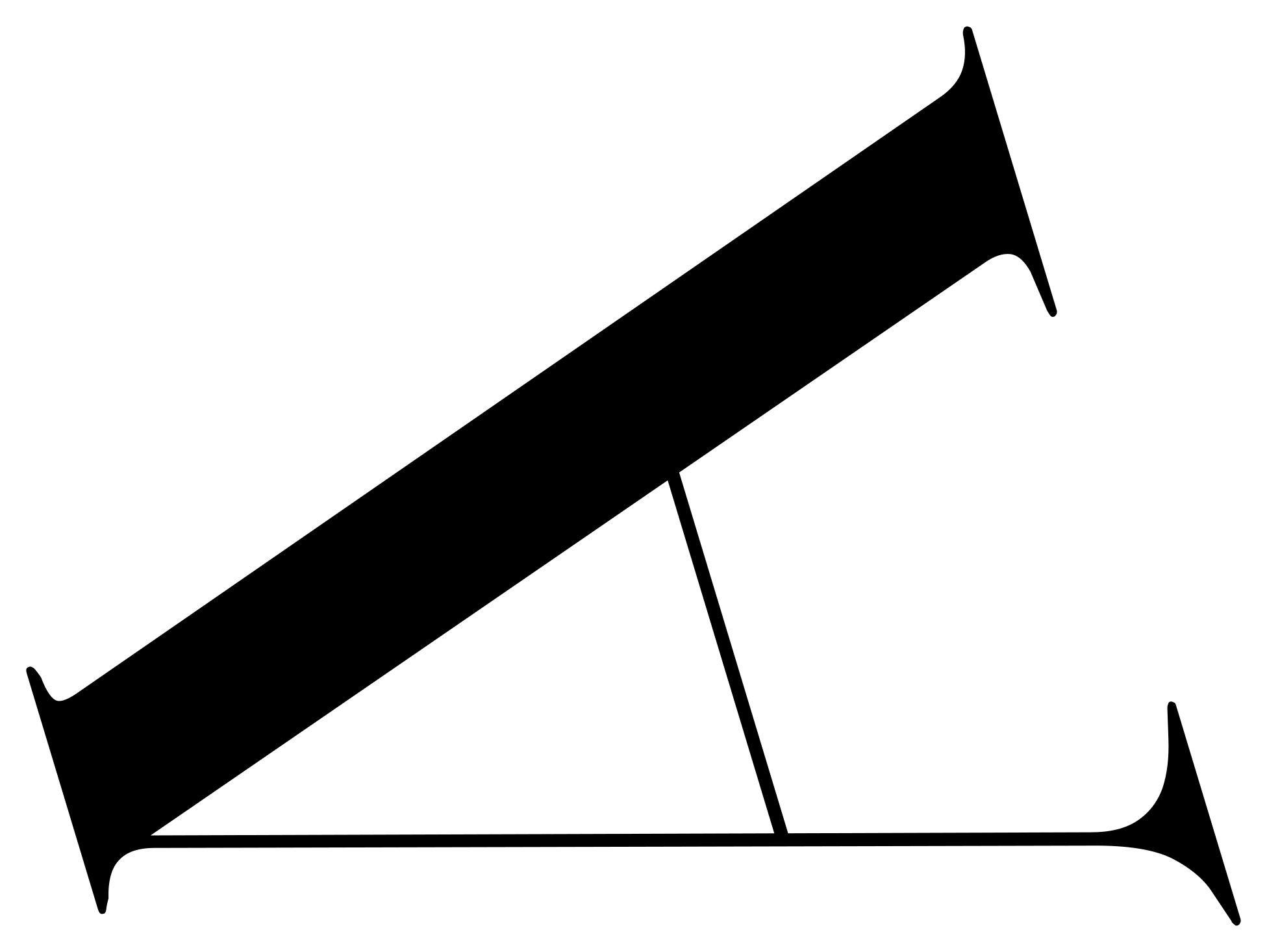
Essay · Trigonometry
Slope and angle aren't the same number
what a 15% treadmill incline is really telling you
A treadmill's 15% incline is a slope, not an angle. It means the belt rises 15
units for every 100 you travel forward — a ratio of 0.15. Turned into an angle
that's arctan(0.15) ≈ 8.53°, not 15°. Percent grade and degrees are
simply two different units.
Set a treadmill to 15% and it feels like a serious hill. So it's natural to picture the deck tilted at 15 degrees. But punch it into a calculator and the tilt is only about eight and a half degrees. The machine isn't lying, and neither is the calculator. They're answering two different questions.
Grade answers "how much do I rise?" — not "how steep is the angle?"
Grade is a ratio: vertical rise divided by horizontal run, written as a percent. A 15% grade is the promise that for every 100 metres you move forward, you climb 15 metres up. That's a statement about two lengths — a triangle's opposite side over its adjacent side.
An angle is a different creature. It's the amount of turn between the flat ground and the slope. To get from one to the other you need the function that trades a ratio for an angle: the arctangent.
angle = arctan( rise / run ) = arctan( 0.15 ) ≈ 8.53°
Why the two numbers drift apart
Here's the part that makes it click. For gentle slopes, grade and angle-in-degrees are almost the same, so the confusion is harmless. A 5% grade is about 2.9° — close enough that nobody notices the gap. But the tangent function curves. As the hill steepens, a little more angle buys a lot more grade, and the two numbers pull away from each other.
The cleanest way to feel it: a 100% grade is 45°, not 100°. Rise equals run, the triangle is a perfect half-square, and the tilt is 45 degrees. Grade can climb past 100% forever — a cliff is infinite grade — but the angle can never reach 90°. Two different rulers for the same hill.
| Grade | As a ratio | Angle |
|---|---|---|
| 5% | 0.05 | 2.86° |
| 10% | 0.10 | 5.71° |
| 15% | 0.15 | 8.53° |
| 20% | 0.20 | 11.31° |
| 30% | 0.30 | 16.70° |
| 50% | 0.50 | 26.57° |
| 100% | 1.00 | 45.00° |
Going the other way
If you know the angle and want the grade, flip the function: grade = tan(angle). A
road sign warning of a 10° descent is really about an 18% grade
(tan(10°) ≈ 0.176). Same triangle, read from the other corner.
Why tangent is the function that does this
There's a reason the slope-to-angle job falls to tangent specifically. Walk a distance of 1 around
a circle centred on the origin and you land at a point whose height is the sine and whose
horizontal reach is the cosine. Tangent is what you get where that same walk crosses the vertical
line at x = 1 — in other words, the height after exactly one unit of forward
travel. Rise per unit of run. Which is precisely what a grade is.
So a road sign reading 10% is quietly reporting a tangent value, and has been all along.
Go stand on it
A 15% slope is easier to believe with your feet than your calculator. Drop the function
z = 0.15x into our browser world and the island becomes exactly that ramp:
walk a 15% grade in Open
World Discover.
Related: chapter 1 is entirely about why a ratio like this one needn't be a slice of a whole — the idea that makes a 100% grade unremarkable instead of paradoxical.